Yes, a mechanism can be designed for both. But a quotation that says “ceramic grinder” does not establish that the proposed assembly suits your salt and pepper. Before using one mechanism across a matching set, confirm the mechanism code, permitted ingredients, component materials and performance in the finished mill.
For a buyer, the attraction is fewer component variants. The risk is approving a common mechanism before defining what customers will put into it. Dry rock salt, damp sea salt and peppercorns should not be collapsed into one “seasoning” line on the specification.
“Ceramic” is a material, not an approved ingredient list
CrushGrind explicitly lists salt and pepper among the uses of its Shaft mechanism. That is evidence for a named product, not every ceramic mechanism sold under the same material description. CrushGrind Shaft specification
A useful counterexample is Peugeot's Zirlion salt mechanism. Peugeot identifies it as zirconia ceramic, yet its Line 18 cm salt-mill specification lists dry salt crystals up to 6 mm and excludes wet salt. That specification does not establish suitability for pepper. The 6 mm limit belongs to that product; it is not a universal salt-grinder threshold. Peugeot Zirlion explanation, Line 18 cm salt-mill specification
“Steel” is equally incomplete. Peugeot distinguishes its steel dry-salt mechanism from its pepper mechanism and says not to use the salt mill for pepper. Ask for the actual material grade and approved use of the offered assembly, rather than treating all metal mechanisms as interchangeable. Peugeot ingredient guidance
These examples establish why the approval must name a mechanism. They are not a recommendation to substitute another manufacturer's part into your product.
Ask for an assembly drawing, not just a close-up of the teeth
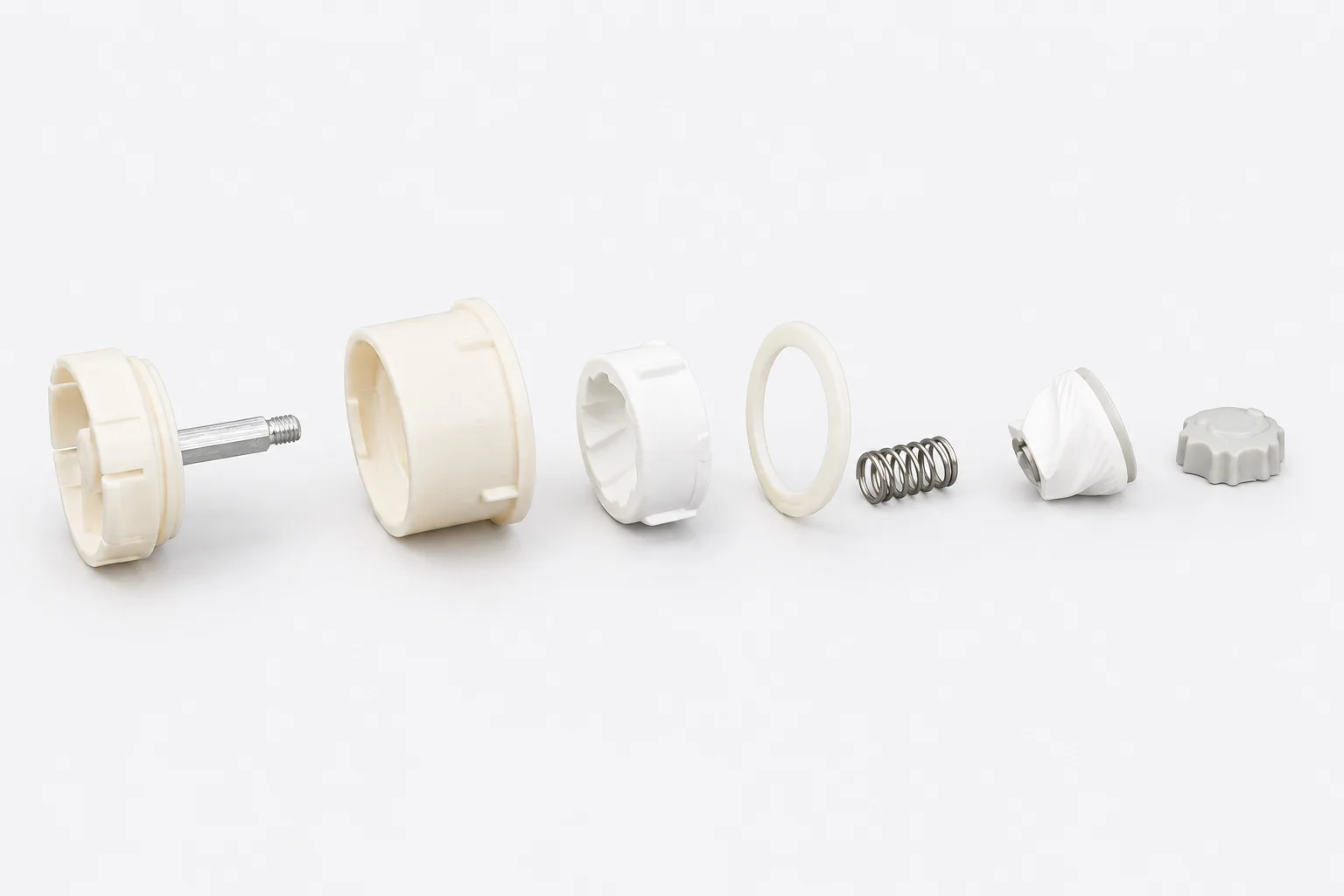
Request an annotated drawing or parts list for the quoted mechanism. It should identify the grinding elements, housing, adjustment parts, shaft and any washers, springs or fasteners actually present. Record the material and finish of each relevant component, including which parts contact the contents.
The distinction is practical: CrushGrind's mechanism overview lists plastics and metals alongside ceramic. A ceramic grinding element does not mean the complete assembly contains no metal. Nor does a material list alone prove how the assembled mill will perform with your chosen salt. CrushGrind component overview
Have the supplier mark three areas on the drawing:
- Feed opening and tooth geometry: Which approved particle sizes can enter, and which drawing revision defines the grinding surfaces? A photograph of similar-looking teeth cannot establish interchangeability.
- Adjustment travel: What controls the gap, where are its limits, and how is the setting retained? Confirm the intended grind range for salt and pepper separately.
- Mounting and drive: Which body dimensions locate the housing, which part transmits rotation, and what prevents the mechanism moving during use? Include the specified tolerances and assembly checks in the drawing package.
These are requests for the supplier's design information, not permission to invent tolerances from a sample photograph.
Verify both fillings in the production body
Use separate, labelled assembled samples for salt and pepper. Record the ingredient supplier, batch, stated particle-size range and condition. A successful pepper demonstration provides no salt result.
For each filling, agree the required output first. Then record how much material is produced over a defined number of complete rotations, whether feeding stops, and whether the adjustment can return to the required result. Photograph or retain the output. Do not treat a shared dial number as proof of equivalent particle size.
Repeat the comparison in the intended body, with the proposed shaft, mounting and adjustment parts. A mechanism demonstrated loose on a bench has not verified those interfaces. Agree sample quantities, repetitions, durability and exposure conditions with the supplier; a short grinding check cannot establish long-term corrosion resistance or service life.
Put the approved identity on the order
The purchasing line should connect mechanism code + drawing revision + approved ingredients + finished-product sample ID. Require review before substituting the grinding elements, shaft, fasteners or housing material, even when the replacement is also described as ceramic.
For an A-LIFE Grinder salt-and-pepper project, send the intended salt specification with the product brief. Confirming that ingredient early makes the discussion about one shared mechanism—or two dedicated mechanisms—specific enough to develop and quote.
Sources checked October 14, 2026.
RELATED READING